


Grain and Oil Conveyor Chains: Operating Conditions, Material Selection and Maintenance
Grain and oil conveyor chains are widely used in grain storage, grain processing, and feed production facilities. They are commonly installed in buried scraper conveyors, bucket elevators, and scraper conveyors to handle bulk materials such as wheat, corn, rice, paddy, bran, soybean meal, and oilseed meal.
Compared with many general industrial conveying environments, grain and oil processing involves higher levels of dust, fine abrasive particles, moisture, and continuous operation. These conditions place greater demands on chain wear resistance, corrosion protection, and material cleanliness.
1. Operating Conditions in Grain and Oil Processing
Grain materials may contain fine hard impurities such as sand and small stones. During long-term operation, these particles cause abrasive wear on pins and bushings. As wear increases, the chain gradually elongates and its pitch changes, potentially affecting sprocket engagement.
In addition, oil residues, moisture, and condensation can increase the risk of corrosion. Many grain and oil processing lines operate continuously for extended periods, often under low-speed and heavy-load conditions. Therefore, conveyor chains need good wear resistance and dimensional stability.
Surface corrosion, detached metal particles, and excessive lubricant can also contaminate grain materials. These factors must be carefully controlled during manufacturing and operation.
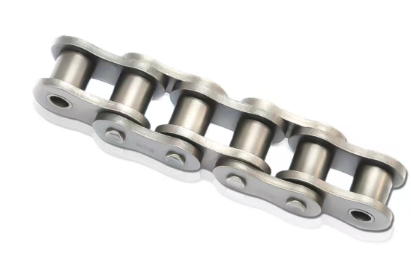
2. Chain Structures and Material Selection
Common structures include sleeve roller chains and plate-type sleeve conveyor chains. Attachment plates or scraper attachments can be configured according to equipment requirements.
Material selection should consider load conditions, wear severity, and the operating environment:
- 40Mn: A cost-effective material commonly used in grain and oil conveyor chains, generally with quenching and tempering treatments.
- 40Cr: Another commonly used material that can be heat-treated according to specific application requirements.
- 20CrMnTi: Typically treated by carburizing and quenching to achieve better surface wear resistance. It is suitable for high-wear applications and long operating cycles.
- Stainless Steel: Suitable for humid environments, applications with significant oil exposure, or situations requiring higher hygiene standards. However, its material cost is relatively higher.
Common surface treatments include blackening and oil immersion. Passivation may also be considered for certain stainless steel applications. Ordinary A3 steel is generally not recommended because it is prone to rusting and surface particle shedding.
3. Grain and Oil Conveyor Chains vs. General Scraper Chains
One of the main differences lies in lubrication requirements and wear-resistant design.
General scraper chains can be lubricated more frequently according to operating conditions. Grain and oil conveyor chains, however, should not be heavily lubricated, as excessive oil may mix with grain materials and cause contamination.
As a result, grain and oil chains rely more on suitable materials and appropriate heat treatment to achieve wear resistance rather than depending on large amounts of lubricant.
Because their operating environments and technical requirements differ, these two types of chains should not be used interchangeably without evaluating the actual application.
4. Manufacturing Requirements and Common Problems
Several manufacturing factors are particularly important for grain and oil conveyor chains, including uniform heat treatment of pins and bushings, controlled machining clearances, reliable scraper attachment welding, and finished-chain pre-stretching.
Properly controlled clearances help reduce the entry of dust into chain joints. Reliable welds reduce the risk of scraper detachment, while pre-stretching before delivery helps minimize initial elongation during the running-in period.
Common failures include rapid chain elongation caused by abrasive wear or insufficient hardness; scraper detachment due to poor welding or impact loads; corrosion caused by moisture and inadequate surface protection; and chain jamming or sprocket tooth jumping caused by excessive chain elongation or guide rail deformation.
5. Selection and Routine Maintenance
A practical selection process should follow this sequence:
Conveying Capacity → Conveyor Casing Model → Chain Speed → Calculated Load → Chain Specification → Material and Heat Treatment.
During installation, chain tension should be properly adjusted, guide rails should remain straight, and the clearance between scrapers and the conveyor casing should be controlled.
For routine maintenance, avoid applying excessive lubricant. If necessary, use a small amount of dry lubricant. Regularly check chain elongation and shorten or replace the chain when it reaches the allowable limit. Clean dust and residual materials from the conveyor casing during shutdowns. In humid environments, empty the remaining materials after shutdown to reduce moisture accumulation and corrosion.
Selecting a grain and oil conveyor chain requires more than considering load capacity alone. Abrasive wear, humidity, hygiene requirements, and continuous operating conditions should all be evaluated. Appropriate chain structures, materials, heat treatment, installation, and maintenance help ensure reliable conveying system performance.
As a professional conveyor chains manufacturer, Matech specializes in conveyor chains, precision castings, and customized industrial components, providing appropriate technical solution and manufacturing support based on customers' equipment parameters and actual application requirements.

 Send E-Mail If You Need Any Help